
Claim Your Emergency Tax Refund in Ireland After Starting a New Job
An Emergency Tax Refund in Ireland may be due if your first Irish payslip shows much less take-home pay than you expected. Seeing nearly half of your hard-earned wages disappear into deductions on your first payday is alarming, yet it is a routine administrative hurdle whenever a payroll department lacks your current Revenue instructions. Before trying to calculate an Emergency Tax Refund in Ireland yourself, ask your payroll team one straightforward question: did it have a Revenue Payroll Notification for you when it ran that payday? The answer tells you whether to register the job, check your existing payroll record, or ask Revenue about your tax basis.
Quick Answer
Give your employer your Personal Public Service Number (PPSN) and make sure Revenue has an active record of the job. Once payroll receives a cumulative Revenue Payroll Notification (RPN), it can automatically calculate and repay excess Income Tax and Universal Social Charge through your normal wages. A Week 1 RPN stops ongoing emergency taxation, but it does not allow payroll to issue an Emergency Tax Refund in Ireland for earlier deductions.
Check Whether Your Payslip Points to an Emergency Tax Refund in Ireland
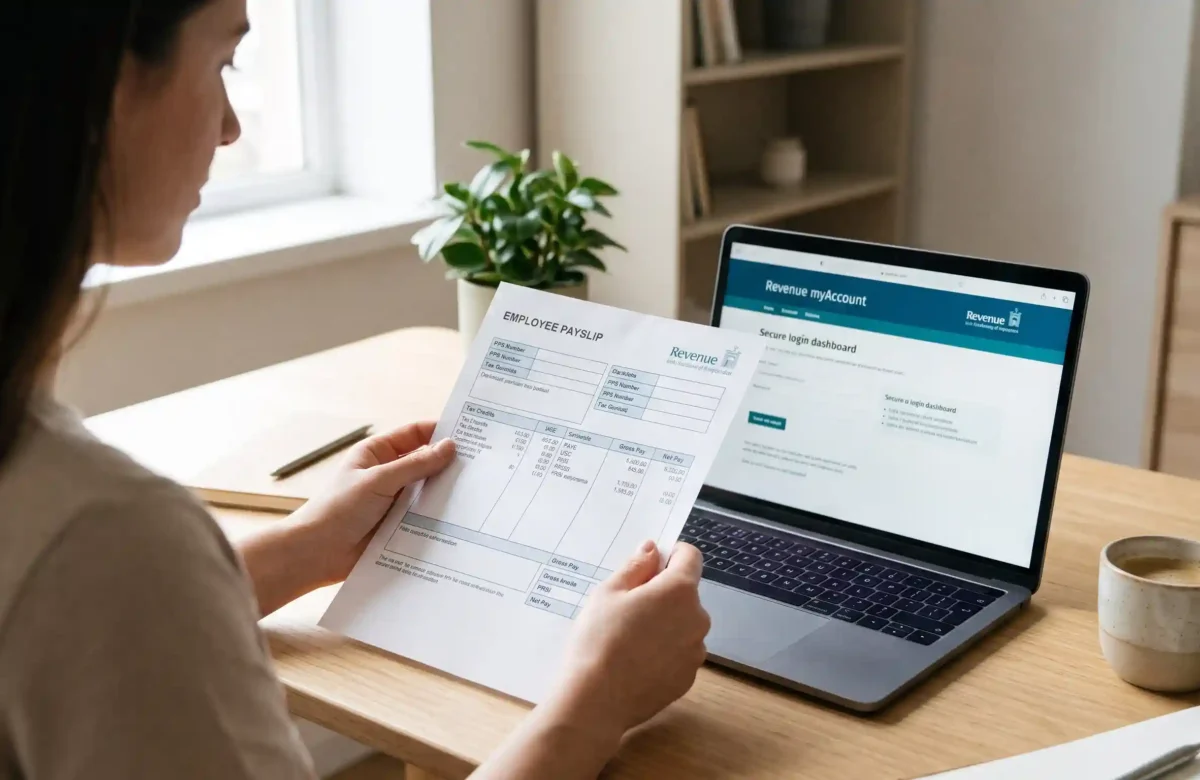
Start by examining the top half of your wage slip rather than jumping straight to the final bank transfer figure. First, compare your gross pay with the hours worked, contracted annual salary, and exact pay period you expected. If you joined a company halfway through a monthly or biweekly cycle, your first payslip may simply cover fewer working days than a standard full cycle. Once you verify that the gross pay figure makes sense, read the Income Tax (PAYE) and Universal Social Charge (USC) lines separately to confirm you are owed an Emergency Tax Refund in Ireland.
Under official Irish Revenue emergency tax rules, employers who do not hold a valid RPN for a new starter must apply punitive temporary rates. If you have provided your PPSN, you receive a single-person standard rate cut-off point for the first four weeks of employment, and from week five onward, all earnings are taxed at the higher 40% rate with zero credits. Alongside that, emergency USC is charged at the top flat rate of 8% on all income without standard lower-band thresholds. Spotting a flat 40% Income Tax deduction or an 8% USC charge on modest earnings is the clearest indicator that an Emergency Tax Refund in Ireland is building up in your favour.
Next, look closely for a tax-basis label on the document, such as “Emergency,” “Cumulative,” or “Week 1 / Month 1.” Every payroll software package formats this differently. If the layout is unclear, send a short email to payroll asking which tax basis it used and the exact pay date it relates to. Keep your first payslip safely stored even after the next one arrives. That original document gives you the baseline figures you will need later when verifying that a payroll correction repaid your full Emergency Tax Refund in Ireland.
Register Your Job and PPSN to Unlock an Emergency Tax Refund in Ireland
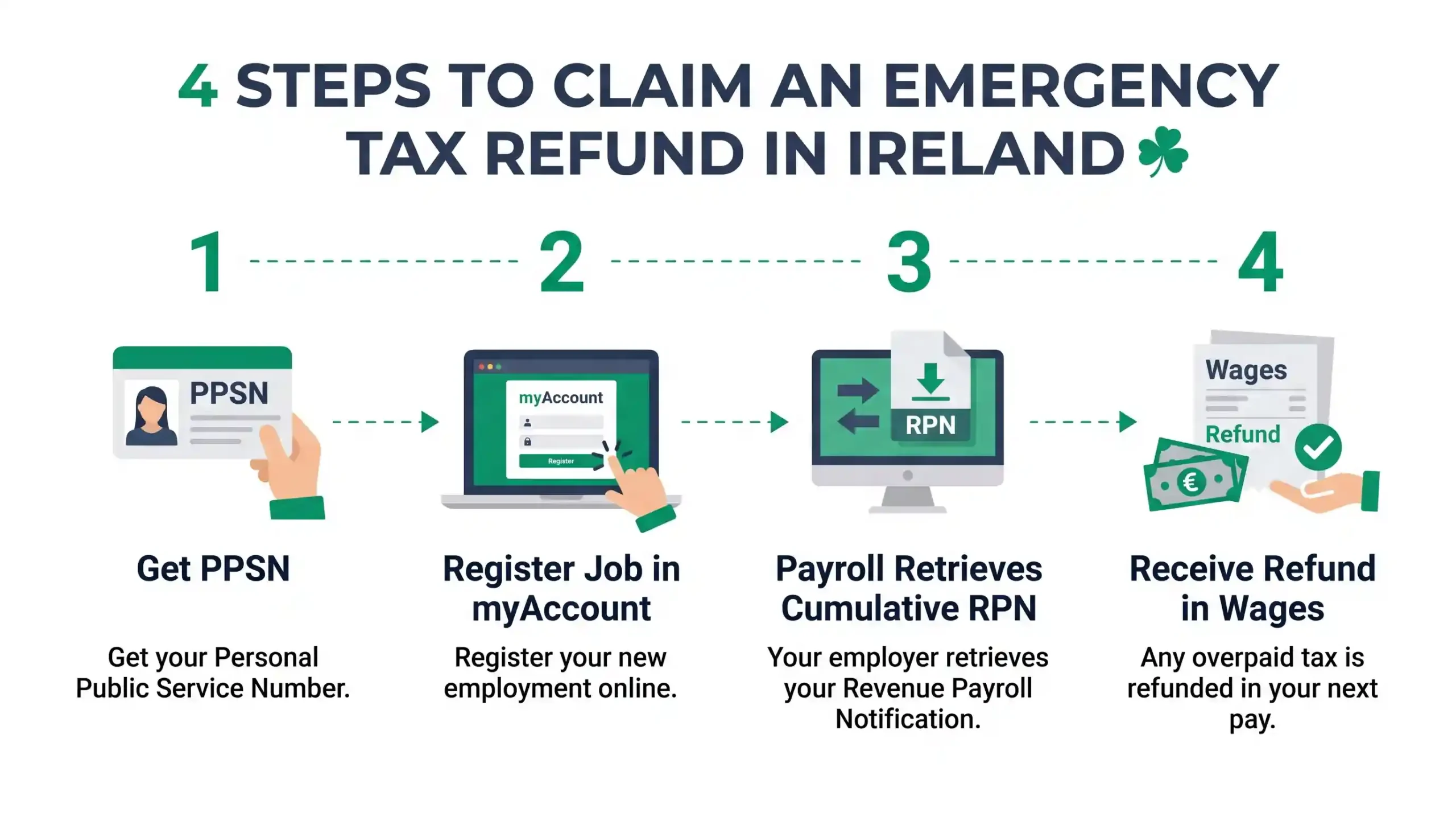
Getting off emergency rates and unlocking your Emergency Tax Refund in Ireland requires two systems to talk to each other: your employer’s payroll software and Revenue’s live PAYE database. Follow these four steps in sequence to connect them without creating duplicate employment records:
- Decide whether this is your first job in the State. If you have never worked in the Republic of Ireland before—for example, if you recently relocated from abroad or just finished full-time education—you must register the new employment yourself through Revenue. Conversely, if you have worked here previously under PAYE, give payroll your PPSN so the employer can register the new job directly on its end. That employer-led rule also applies when you take on a second job while keeping your first role.
- Collect the exact details needed for a first registration. Before logging into any portal, gather your PPSN, your official start date, your frequency of pay (weekly, fortnightly, or monthly), and your employer’s tax registration number. Ask your HR contact or payroll administrator for that tax registration number. The retail store name printed on your staff badge or storefront often differs from the registered legal entity shown on your payslip and Revenue records.
- Use Revenue’s myAccount for your first Irish job. Sign in to Revenue myAccount, navigate to the PAYE Services card, and select “Add Job or Pension Details.” Enter your start date and the employer’s tax registration number exactly as provided. If you have arrived recently and do not hold a PPSN yet, you must apply for a PPSN via Gov.ie through the Department of Social Protection first, because neither you nor your employer can link a tax record or process an Emergency Tax Refund in Ireland until a PPSN is issued.
- Close the loop with your payroll department. Once you submit the registration online, message your payroll team to confirm it is complete and verify that they hold your accurate PPSN through their normal secure HR channel. Ask two specific questions: whether the team can now retrieve your RPN from Revenue, and which upcoming pay run will apply that updated instruction to release your Emergency Tax Refund in Ireland.
If you already hold an existing Irish employment record, inspect the active employments listed inside PAYE Services in myAccount. Seeing two active jobs at the same time can be completely normal if you genuinely work two roles. However, if you left your previous workplace weeks ago and it still shows as active, check its cessation date before you reallocate tax credits and rate bands. An old workplace that forgot to submit a final payroll cessation notice and a genuine second job require very different follow-up actions to unlock your Emergency Tax Refund in Ireland.
Choose the Right Route for Your Emergency Tax Refund in Ireland
How you receive your Emergency Tax Refund in Ireland depends entirely on your current employment status and the type of RPN Revenue issues to your employer. Use the breakdown below to identify who holds the power to issue your repayment right now:
| Your Current Position | Who Can Act Next | What to Check & Confirm |
|---|---|---|
| Still employed, cumulative RPN | Your employer’s payroll team | Which upcoming payday uses the new instruction and reflects any overpayment refund. |
| Still employed, Week 1 RPN | Revenue through MyEnquiries | Why the non-cumulative basis applies and what details Revenue needs to switch you to cumulative. |
| Moved to a new employer this tax year | The new employer’s payroll team | Whether the new payroll team has retrieved a cumulative RPN covering your year-to-date earnings. |
| Left work and are now unemployed | Revenue directly | The unemployment repayment service inside PAYE Services in Revenue myAccount. |
| Deductions relate to a previous tax year | You, through Revenue myAccount | Your Income Tax Return and Statement of Liability for the specific past year you want reviewed. |
How a Cumulative RPN Delivers an Automatic Emergency Tax Refund in Ireland
A cumulative calculation looks backward across the entire Irish tax year from 1 January to the current pay date. For example, suppose you paid heavy emergency deductions on your first two weekly payslips in October. When payroll subsequently downloads a cumulative RPN, its software totals your gross earnings since January, applies your full year-to-date tax credits and standard rate cut-off points, and compares what you actually owed against what was already deducted. Any excess Income Tax and USC immediately becomes a negative tax figure—meaning your Emergency Tax Refund in Ireland is added directly onto your net wages on the very next pay run.
Why a Week 1 RPN Pauses Your Past Refund
By comparison, a Week 1 (or Month 1) basis treats each individual pay period in isolation, ignoring what you earned or paid in previous weeks. That explains a common frustration: your current weekly deductions suddenly drop to normal levels, yet the earlier Emergency Tax Refund in Ireland you were expecting never shows up in your bank account. Revenue often places a new job on Week 1 temporarily when you have multiple employments, missing prior pay details, or unallocated credits. If payroll confirms it holds a Week 1 instruction, send a message to Revenue through MyEnquiries asking why Week 1 applies in your circumstances. Your employer legally cannot release an Emergency Tax Refund in Ireland for earlier pay periods until Revenue sends a cumulative instruction.
Claiming Overpaid Tax From a Previous Calendar Year
Once 31 December passes, an employer can no longer issue an Emergency Tax Refund in Ireland for deductions taken during the closed tax year through current payroll. Instead, open the Review your tax for the previous 4 years option inside PAYE Services in myAccount. Select the relevant year, request a Statement of Liability, and complete the brief Income Tax Return form. Before clicking submit, double-check that you selected the exact calendar year printed on the payslip’s pay date. A final December wage paid in early January belongs to the new tax year, so matching the payment date prevents filing paperwork under the wrong year.
Common Mistakes When Checking an Emergency Tax Refund in Ireland
- Treating every single deduction on the payslip as refundable. Your payslip frequently lists occupational pension contributions, Pay Related Social Insurance (PRSI), bike-to-work deductions, or health insurance premiums alongside Income Tax and USC. Focus strictly on the Income Tax and USC lines that Revenue identifies for an Emergency Tax Refund in Ireland. PRSI is calculated on a separate social insurance basis; if a PRSI class looks wrong, raise a separate query about that specific line rather than expecting it to bundle into your tax rebate.
- Registering the exact same job twice in myAccount. When an Emergency Tax Refund in Ireland does not land immediately, anxious employees sometimes log back into myAccount and add the employment a second time. If the job already appears under your active employments, compare its listed start date and employer registration number against your payslip. If they match, contact payroll to verify whether it has refreshed its RPN feed. Creating a duplicate employment splits your tax credits across two records and delays your Emergency Tax Refund in Ireland even further.
- Counting on a specific Friday payday without checking payroll cut-offs. Payroll teams run wages several days ahead of the actual bank transfer date. Even if Revenue issues your cumulative RPN on a Wednesday morning, your company may have already locked Friday’s payroll file on Tuesday afternoon. Always ask payroll which specific payday will reflect the update so you can plan rent and direct debits around realistic dates.
Pro Tips for Verifying Your Next Payslip
When the updated payslip arrives, place your emergency payslip and your new payslip side by side. Highlight five figures on both documents: the pay period dates, gross pay, Income Tax deducted, USC deducted, and the year-to-date (YTD) totals at the bottom. Next, check whether you worked overtime, earned commission, or changed shifts during the new period. Looking at your bank balance alone cannot tell you how much of a bigger deposit came from your Emergency Tax Refund in Ireland versus extra hours worked.
Look at the Income Tax and USC columns on the new payslip: during a cumulative correction, one or both lines often display a minus sign (for example, -€412.50), confirming that payroll credited the overpaid tax straight back into your net pay. If the Emergency Tax Refund in Ireland is large enough that it exceeds your tax liability for a single week, some employers spread the remaining balance over two consecutive pay runs depending on their cash-flow settings—ask payroll if a balance remains in your YTD figures.
Whenever you need to contact Revenue via MyEnquiries, keep your message concise and structured. Include your job start date, the exact pay dates affected by emergency deductions, and the RPN basis your payroll team confirmed. Writing a direct note such as, “My employer confirms it holds a Week 1 RPN for my employment starting [Date]. Please review my record and let me know what details you need to issue a cumulative RPN,” gives the Revenue caseworker an immediate action to resolve.
Frequently Asked Questions
Will my employer pay my Emergency Tax Refund in Ireland automatically?
Yes, provided you still work for that employer in the same tax year and payroll receives a cumulative RPN from Revenue. Once that instruction lands in their system, payroll software automatically recalculates your year-to-date tax and adds the Emergency Tax Refund in Ireland to your regular wages. If your employer only holds a Week 1 instruction, contact Revenue via MyEnquiries to review your basis.
Can I get an Emergency Tax Refund in Ireland if I changed jobs mid-year?
Yes. If you moved to a new employer within the same calendar tax year before receiving your rebate, your new employer can issue the Emergency Tax Refund in Ireland once it downloads a cumulative RPN. Check myAccount to confirm your old employer has recorded a finish date and your new job is active, then ask your new payroll team which pay run will apply the cumulative RPN.
What if I left the job and currently have no new employer?
If you stopped working and are unemployed, you can claim your Emergency Tax Refund in Ireland directly from Revenue rather than waiting on a former employer. Sign in to Revenue myAccount, open PAYE Services, and select the unemployment repayment option. Keep your leaving date and final payslip close by so you can verify the figures submitted.
Does a Week 1 payslip mean I am still paying Emergency Tax?
No. A Week 1 (or Month 1) label means Revenue has issued an RPN for you, so you are no longer on punitive emergency tax rates. Instead, you are being taxed on a non-cumulative basis where each payday stands alone. While your current tax deductions will look much healthier, you will need to ask Revenue to switch you to a cumulative basis before any Emergency Tax Refund in Ireland from earlier paydays can be released.
How long does it take for an Emergency Tax Refund in Ireland to reach my bank account?
Once you register your job or supply your PPSN, Revenue typically updates your RPN within one to two working days. Your employer then applies that cumulative RPN on its next scheduled payroll run. For weekly-paid staff, an Emergency Tax Refund in Ireland usually arrives within one to two weeks; for monthly-paid staff, it arrives on your next monthly payday.
Know Exactly What to Check Before Next Payday
Log into Revenue myAccount today to verify that your new job is listed with the right start date, ask your payroll team whether they hold a cumulative or Week 1 RPN, and note down the exact cut-off date for the upcoming pay run. When that next payslip arrives, compare the Income Tax and USC lines directly against your original payslip to confirm your Emergency Tax Refund in Ireland has been paid in full.
Last updated: November 27, 2026.
